

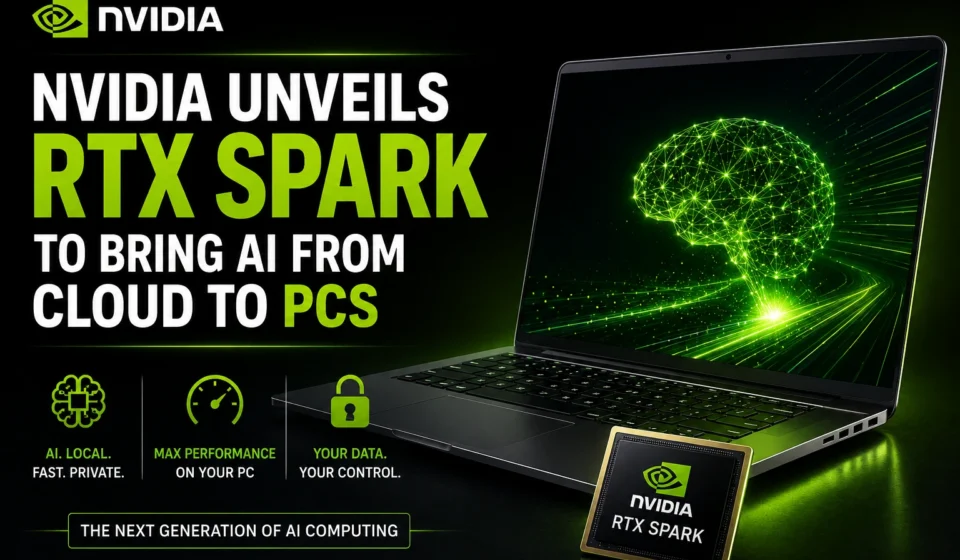

Nvidia has unveiled RTX Spark, a new AI-focused superchip designed to bring advanced artificial intelligence capabilities directly to Windows PCs and laptops.
The launch represents a major shift in how AI applications are expected to run in the future. Instead of relying primarily on cloud-based servers and remote data centers, RTX Spark enables AI processing to happen directly on local devices.
As demand for AI-powered tools continues to grow, Nvidia is positioning itself at the center of the emerging AI PC revolution.
What Is Nvidia RTX Spark?
RTX Spark is a next-generation AI computing platform built specifically for personal computers.
The chip is designed to handle demanding AI workloads directly on:
- Windows laptops
- Desktop PCs
- Workstations
- AI-powered productivity devices
By moving AI processing closer to users, Nvidia aims to deliver faster, more private, and more efficient AI experiences.
Bringing AI From the Cloud to the Device
For years, most advanced AI applications have depended heavily on cloud infrastructure.
Tasks such as:
- AI chatbots
- image generation
- coding assistance
- video enhancement
- language translation
typically require powerful remote servers to process requests.
RTX Spark changes this model by allowing many AI tasks to run locally on the device itself.
This reduces dependence on cloud computing and opens the door to a new generation of AI-powered PCs.
Why Local AI Matters
Running AI directly on a laptop or desktop offers several advantages.
Faster Performance
Local processing can reduce delays caused by sending requests to remote servers.
Better Privacy
Sensitive information can remain on the device rather than being transmitted to external data centers.
Offline AI Capabilities
Certain AI features may continue working even without an internet connection.
Reduced Cloud Costs
Businesses and developers may lower infrastructure expenses by processing more AI workloads locally.
Nvidia’s Push Into Consumer AI PCs
The RTX Spark announcement highlights Nvidia’s growing focus on consumer computing.
Traditionally known for gaming GPUs and data center hardware, Nvidia is now expanding aggressively into the AI PC market.
The company sees personal AI computing as one of the next major growth opportunities as AI becomes integrated into everyday workflows.
The launch also reflects increasing competition among technology companies seeking to define the future of AI-powered devices.
Competing in the AI Hardware Race
Nvidia is not alone in pursuing AI-focused computing.
Several major technology companies are investing heavily in AI-ready hardware, including:
- Microsoft
- Intel
- AMD
- Qualcomm
- Apple
The goal is to create devices capable of running increasingly powerful AI models without requiring constant cloud connectivity.
This shift could transform how users interact with software across work, education, and entertainment.
What RTX Spark Could Enable
With powerful local AI processing, future PCs and laptops may support:
- advanced AI assistants
- real-time content creation
- intelligent coding tools
- AI-enhanced productivity software
- image and video generation
- personalized automation
Many of these capabilities currently rely on cloud infrastructure but may gradually move to local devices as hardware improves.
Why This Is Important for Businesses
Businesses are increasingly interested in local AI solutions because they offer:
- improved security
- lower operating costs
- reduced latency
- greater control over sensitive data
Organizations handling confidential information may particularly benefit from AI systems that can operate without transmitting data to external servers.
The Future of AI PCs
Industry experts believe AI PCs could become one of the most important categories in personal computing over the next decade.
Future devices may include dedicated AI hardware capable of running increasingly sophisticated models directly on consumer hardware.
As AI becomes a standard part of everyday computing, local processing may play a much larger role alongside traditional cloud-based AI services.
RTX Spark represents an early step toward that future.
Conclusion
Nvidia’s RTX Spark launch marks a significant milestone in the evolution of AI-powered computing. By bringing advanced AI capabilities directly to PCs and laptops, Nvidia is helping shift AI processing from cloud data centers to personal devices.
As businesses and consumers demand faster, more private, and more efficient AI experiences, technologies like RTX Spark could play a major role in shaping the next generation of personal computing.