

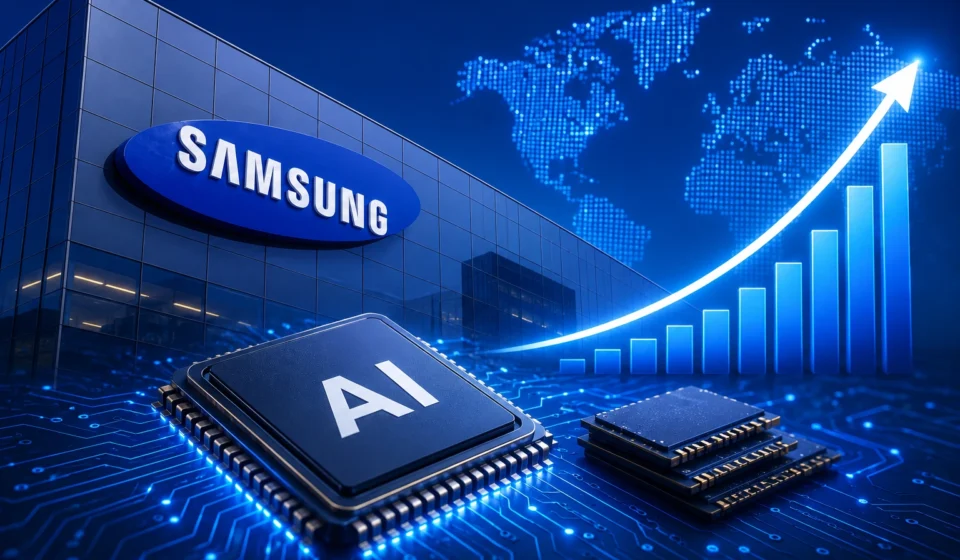

Samsung Electronics has reportedly crossed a major financial milestone, surpassing a $1 trillion market valuation as investor enthusiasm around artificial intelligence continues to grow.
The company’s rise is being fueled by strong demand for:
- AI chips
- Memory semiconductors
- High-performance computing hardware
- AI infrastructure technology
As the global AI boom accelerates, Samsung is emerging as one of the biggest beneficiaries of the growing demand for advanced semiconductor technology.
Why Samsung’s $1 Trillion Valuation Matters
Reaching a trillion-dollar valuation places Samsung among the world’s most valuable technology companies.
The milestone reflects:
- Growing confidence in AI infrastructure
- Rising semiconductor demand
- Strong investor optimism around AI-related businesses
It also highlights how important hardware companies have become in the AI era.
How AI Is Driving Samsung’s Growth
Artificial intelligence requires enormous computing power.
AI systems depend heavily on:
- Advanced memory chips
- Data center hardware
- AI accelerators
- High-bandwidth semiconductor technology
Samsung plays a major role in supplying these critical components.
Key Areas Benefiting From AI Growth:
- AI memory chips
- High-bandwidth memory (HBM)
- Semiconductor manufacturing
- Data center infrastructure
As AI adoption expands globally, demand for Samsung’s hardware continues to rise.
AI Chip Demand Is Exploding
One major reason behind Samsung’s valuation increase is the rapid growth of AI chip demand.
Generative AI systems require:
- Massive computational resources
- Faster memory processing
- Large-scale data infrastructure
This has created huge demand for advanced semiconductor companies.
Samsung’s semiconductor division is benefiting directly from:
- AI data centers
- Cloud computing growth
- Enterprise AI expansion
The AI Boom Is Transforming the Semiconductor Industry
The rise of AI has completely changed the semiconductor market.
Companies are now investing billions into:
- AI servers
- Cloud infrastructure
- Machine learning systems
- AI-powered computing platforms
This has increased demand for:
- Memory chips
- GPUs
- Advanced processors
Samsung’s position in the global semiconductor market makes it a key player in this transformation.
Samsung’s Role in the Global AI Ecosystem
Samsung is involved in multiple industries connected to AI growth.
These include:
- Smartphones
- AI-enabled consumer electronics
- Semiconductor manufacturing
- Cloud infrastructure hardware
The company is not only benefiting from AI directly but also from the wider expansion of digital technologies worldwide.
Why Investors Are Bullish on Samsung
Investors believe AI will continue driving long-term growth for semiconductor companies.
Samsung is seen as a strong AI-related investment because of:
- Its massive semiconductor business
- AI memory leadership
- Global manufacturing scale
- Strong technology ecosystem
As AI infrastructure spending increases, companies supplying critical hardware are expected to benefit significantly.
Competition in the AI Hardware Race
Samsung is competing with several major technology companies in the AI hardware market, including:
- NVIDIA
- TSMC
- Intel
The competition is focused on:
- AI chips
- Advanced memory technology
- Semiconductor production capacity
The global AI race is creating enormous opportunities for hardware manufacturers.
What This Means for the Future
Samsung’s trillion-dollar valuation shows how AI is reshaping the global technology industry.
The AI boom is no longer limited to software companies. Hardware and semiconductor businesses are now becoming central to the future of artificial intelligence.
As AI adoption continues expanding across industries, demand for advanced chips and computing infrastructure is expected to remain strong.
Conclusion
Samsung’s rise to a $1 trillion valuation highlights the massive impact AI is having on the global technology market. Growing demand for AI chips, semiconductors, and cloud infrastructure has positioned Samsung as one of the biggest winners of the AI revolution.
As artificial intelligence continues transforming industries worldwide, companies powering the hardware behind AI are likely to play an even bigger role in the future.