

Skip to content
Techneel logo Techneel logo white Techneel
  • Home
  • Tech News
  • Write for Us
  • About
  • Contact
  • Home
  • Tech News
  • Write for Us
  • About
  • Contact
Close

Search

Subscribe
Techneel logo Techneel logo white Techneel
  • Home
  • Tech News
  • Write for Us
  • About
  • Contact
  • Home
  • Tech News
  • Write for Us
  • About
  • Contact
Close

Search

Subscribe
Home/Technology/AI Is Helping Researchers Translate 3,500-Year-Old Ancient Texts
AI Is Helping Researchers Translate 3,500-Year-Old Ancient Texts
Technology

AI Is Helping Researchers Translate 3,500-Year-Old Ancient Texts

By Techneel
May 25, 2026 3 Min Read
0

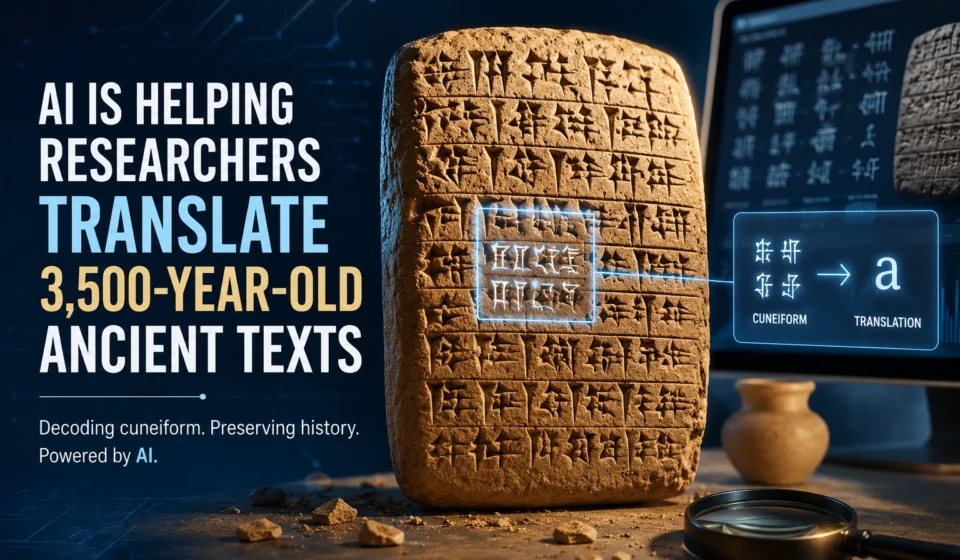
Artificial intelligence is now helping researchers unlock some of humanity’s oldest written records.

Scientists and historians are increasingly using AI systems to reconstruct, transcribe, and translate ancient cuneiform texts written more than 3,500 years ago on clay tablets.

The development highlights how AI is expanding far beyond chatbots and automation into areas such as:

  • archaeology
  • language preservation
  • historical research
  • ancient civilization studies

By combining machine learning and computer vision, researchers are discovering new ways to decode damaged ancient texts that were once extremely difficult to interpret.

Table of Contents

Toggle
  • What Is Cuneiform?
  • How AI Is Helping Translate Ancient Texts
  • Why Ancient Text Translation Is Difficult
  • AI Is Becoming a Tool for Historical Discovery
  • Why This Breakthrough Matters
  • Could AI Help Preserve Human History?
  • AI Still Requires Human Experts
  • The Future of AI in Archaeology
  • A New Era of AI-Assisted Knowledge Discovery
  • Conclusion

What Is Cuneiform?

Cuneiform is one of the world’s oldest known writing systems.

It was used by ancient civilizations in Mesopotamia, including:

  • Sumerians
  • Akkadians
  • Babylonians
  • Assyrians

The script was typically carved into clay tablets using wedge-shaped symbols.

These tablets contain valuable historical information about:

  • trade
  • politics
  • religion
  • science
  • daily life in ancient civilizations

How AI Is Helping Translate Ancient Texts

Researchers are using AI technologies such as:

  • machine learning
  • computer vision
  • pattern recognition
  • language modeling

to analyze ancient tablets more efficiently.

AI systems can help:

  • identify damaged symbols
  • reconstruct missing text
  • transcribe inscriptions
  • suggest possible translations

This significantly speeds up processes that traditionally required years of manual analysis.


Why Ancient Text Translation Is Difficult

Many ancient tablets are:

  • broken
  • faded
  • incomplete
  • physically damaged

Some ancient languages also have:

  • limited reference material
  • incomplete dictionaries
  • complex symbol systems

This makes translation extremely challenging, even for experts.

AI can assist by recognizing patterns across massive datasets of ancient writing.


AI Is Becoming a Tool for Historical Discovery

The use of AI in archaeology represents a growing trend where artificial intelligence supports scientific and historical research.

AI is increasingly being used in:

  • archaeology
  • astronomy
  • biology
  • mathematics
  • climate science

Instead of simply automating modern tasks, AI is now helping researchers better understand the human past.


Why This Breakthrough Matters

Ancient texts contain valuable insights into:

  • early civilizations
  • human culture
  • economic systems
  • political history
  • scientific knowledge

Many tablets remain untranslated because of the enormous amount of work involved.

AI could help historians process large collections of ancient documents much faster than before.


Could AI Help Preserve Human History?

Researchers believe AI may eventually become an important tool for preserving endangered historical records and ancient languages.

Future AI systems could potentially:

  • restore damaged manuscripts
  • translate forgotten languages
  • digitally archive ancient artifacts
  • improve historical accessibility

This could help preserve cultural heritage for future generations.


AI Still Requires Human Experts

Despite its capabilities, AI does not replace historians or archaeologists.

Human experts are still essential for:

  • verifying translations
  • understanding historical context
  • interpreting meanings accurately
  • validating AI-generated results

AI currently works best as a research assistant rather than a fully independent translator.


The Future of AI in Archaeology

As AI technology improves, researchers may gain access to:

  • faster historical analysis
  • automated reconstruction systems
  • smarter translation tools
  • improved artifact preservation

AI-assisted archaeology could dramatically accelerate discoveries about ancient civilizations.


A New Era of AI-Assisted Knowledge Discovery

The ability of AI to help decode ancient writing demonstrates how artificial intelligence is evolving into a broader discovery tool.

From mathematics to archaeology, AI is increasingly contributing to fields that require:

  • reasoning
  • pattern analysis
  • interpretation
  • complex problem-solving

This may reshape how future generations study science, history, and culture.


Conclusion

AI helping researchers translate 3,500-year-old cuneiform texts marks a fascinating intersection between ancient history and modern technology. By using machine learning and computer vision to analyze ancient clay tablets, researchers are uncovering historical knowledge that may have remained hidden for centuries.

While human expertise remains essential, AI is proving to be a powerful tool for preserving and understanding humanity’s oldest written records.

Author

Techneel

Follow Me
Other Articles
OpenAI AI Model Solves 80-Year-Old Math Problem in Major Geometry Breakthrough
Previous

OpenAI AI Model Solves 80-Year-Old Math Problem in Major Geometry Breakthrough

China Develops Laser-Powered 6G Engine With 1.2 km Data Transmission
Next

China Develops Laser-Powered 6G Engine With 1.2 km Data Transmission

No Comment! Be the first one.

Leave a Reply Cancel reply

Your email address will not be published. Required fields are marked *

Recent Posts

  • Anthropic Launches Claude Opus 5 With Advanced AI Capabilities
  • Meta Withdraws AI Tool That Used Instagram Photos
  • OpenAI Launches GPT-5.6 With Smarter AI Models
  • Meta Launches Muse AI to Compete With ChatGPT and Gemini
  • Google Search Console Adds Social Video Platform Properties

Recent Comments

No comments to show.

Archives

  • July 2026
  • June 2026
  • May 2026
  • April 2026

Categories

  • Technology
  • Uncategorized

Recent Posts

  • Anthropic Launches Claude Opus 5 With Advanced AI Capabilities
    Anthropic Launches Claude Opus 5 With Advanced AI Capabilities
    by Techneel
    July 28, 2026
  • How AI Is Transforming Everyday Life in 2026
    by Techneel
    April 11, 2026
  • Top Gadgets You Should Watch in 2026
    by Techneel
    April 11, 2026
  • Why Cybersecurity Matters More Than Ever in a Hyperconnected World
    by Techneel
    April 11, 2026
Techneel logo
Techneel logo white

Techneel is a technology news and guest posting platform covering AI, startups, software, and digital trends.

  • Facebook
  • Instagram
  • LinkedIn

Latest Posts

  • YouTube Search Is Changing Forever? Google Tests ‘Ask YouTube’ AI Feature
    Google is once again pushing the boundaries of AI-powered search.… Read more: YouTube Search Is Changing Forever? Google Tests ‘Ask YouTube’ AI Feature
  • YouTube Now Auto-Detects AI Content and Labels It for Viewers
    YouTube is expanding its AI transparency efforts by automatically detecting… Read more: YouTube Now Auto-Detects AI Content and Labels It for Viewers
  • WordPress 7.0 Launches With Native AI Integration
    WordPress is entering a new AI-powered era with the launch… Read more: WordPress 7.0 Launches With Native AI Integration

Pages

  • Write for Us
  • About
  • Contact
  • Terms and conditions
  • Privacy Policy

Contact

Email

info@techneel.com

Copyright 2026 — Techneel. All rights reserved.

Powered by
Necessary cookies enable essential site features like secure log-ins and consent preference adjustments. They do not store personal data.
None
Functional cookies support features like content sharing on social media, collecting feedback, and enabling third-party tools.
None
Analytical cookies track visitor interactions, providing insights on metrics like visitor count, bounce rate, and traffic sources.
None
Advertisement cookies deliver personalized ads based on your previous visits and analyze the effectiveness of ad campaigns.
None
Unclassified cookies are cookies that we are in the process of classifying, together with the providers of individual cookies.
None
Powered by

Table of Contents

×
  • What Is Cuneiform?
  • How AI Is Helping Translate Ancient Texts
  • Why Ancient Text Translation Is Difficult
  • AI Is Becoming a Tool for Historical Discovery
  • Why This Breakthrough Matters
  • Could AI Help Preserve Human History?
  • AI Still Requires Human Experts
  • The Future of AI in Archaeology
  • A New Era of AI-Assisted Knowledge Discovery
  • Conclusion
→ Index