
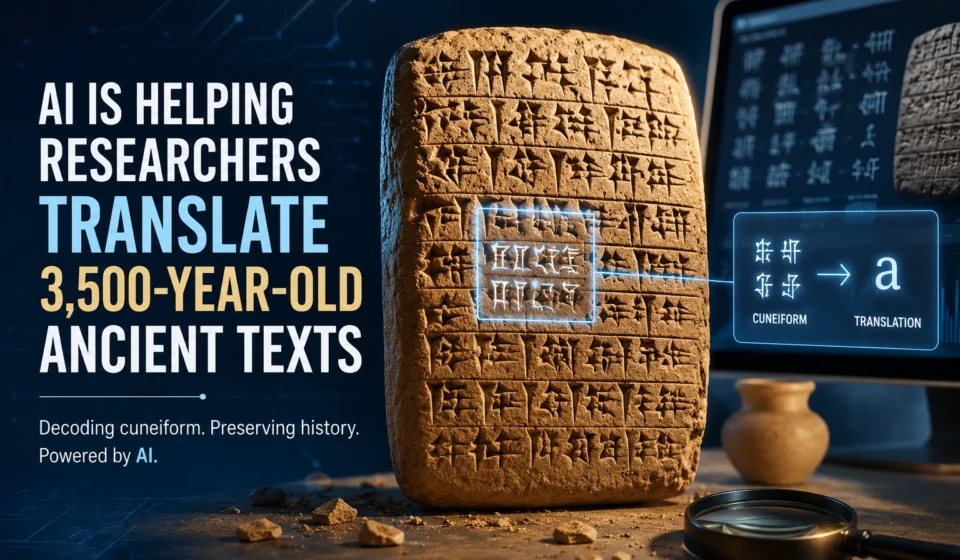

Artificial intelligence is now helping researchers unlock some of humanity’s oldest written records.
Scientists and historians are increasingly using AI systems to reconstruct, transcribe, and translate ancient cuneiform texts written more than 3,500 years ago on clay tablets.
The development highlights how AI is expanding far beyond chatbots and automation into areas such as:
- archaeology
- language preservation
- historical research
- ancient civilization studies
By combining machine learning and computer vision, researchers are discovering new ways to decode damaged ancient texts that were once extremely difficult to interpret.
What Is Cuneiform?
Cuneiform is one of the world’s oldest known writing systems.
It was used by ancient civilizations in Mesopotamia, including:
- Sumerians
- Akkadians
- Babylonians
- Assyrians
The script was typically carved into clay tablets using wedge-shaped symbols.
These tablets contain valuable historical information about:
- trade
- politics
- religion
- science
- daily life in ancient civilizations
How AI Is Helping Translate Ancient Texts
Researchers are using AI technologies such as:
- machine learning
- computer vision
- pattern recognition
- language modeling
to analyze ancient tablets more efficiently.
AI systems can help:
- identify damaged symbols
- reconstruct missing text
- transcribe inscriptions
- suggest possible translations
This significantly speeds up processes that traditionally required years of manual analysis.
Why Ancient Text Translation Is Difficult
Many ancient tablets are:
- broken
- faded
- incomplete
- physically damaged
Some ancient languages also have:
- limited reference material
- incomplete dictionaries
- complex symbol systems
This makes translation extremely challenging, even for experts.
AI can assist by recognizing patterns across massive datasets of ancient writing.
AI Is Becoming a Tool for Historical Discovery
The use of AI in archaeology represents a growing trend where artificial intelligence supports scientific and historical research.
AI is increasingly being used in:
- archaeology
- astronomy
- biology
- mathematics
- climate science
Instead of simply automating modern tasks, AI is now helping researchers better understand the human past.
Why This Breakthrough Matters
Ancient texts contain valuable insights into:
- early civilizations
- human culture
- economic systems
- political history
- scientific knowledge
Many tablets remain untranslated because of the enormous amount of work involved.
AI could help historians process large collections of ancient documents much faster than before.
Could AI Help Preserve Human History?
Researchers believe AI may eventually become an important tool for preserving endangered historical records and ancient languages.
Future AI systems could potentially:
- restore damaged manuscripts
- translate forgotten languages
- digitally archive ancient artifacts
- improve historical accessibility
This could help preserve cultural heritage for future generations.
AI Still Requires Human Experts
Despite its capabilities, AI does not replace historians or archaeologists.
Human experts are still essential for:
- verifying translations
- understanding historical context
- interpreting meanings accurately
- validating AI-generated results
AI currently works best as a research assistant rather than a fully independent translator.
The Future of AI in Archaeology
As AI technology improves, researchers may gain access to:
- faster historical analysis
- automated reconstruction systems
- smarter translation tools
- improved artifact preservation
AI-assisted archaeology could dramatically accelerate discoveries about ancient civilizations.
A New Era of AI-Assisted Knowledge Discovery
The ability of AI to help decode ancient writing demonstrates how artificial intelligence is evolving into a broader discovery tool.
From mathematics to archaeology, AI is increasingly contributing to fields that require:
- reasoning
- pattern analysis
- interpretation
- complex problem-solving
This may reshape how future generations study science, history, and culture.
Conclusion
AI helping researchers translate 3,500-year-old cuneiform texts marks a fascinating intersection between ancient history and modern technology. By using machine learning and computer vision to analyze ancient clay tablets, researchers are uncovering historical knowledge that may have remained hidden for centuries.
While human expertise remains essential, AI is proving to be a powerful tool for preserving and understanding humanity’s oldest written records.