

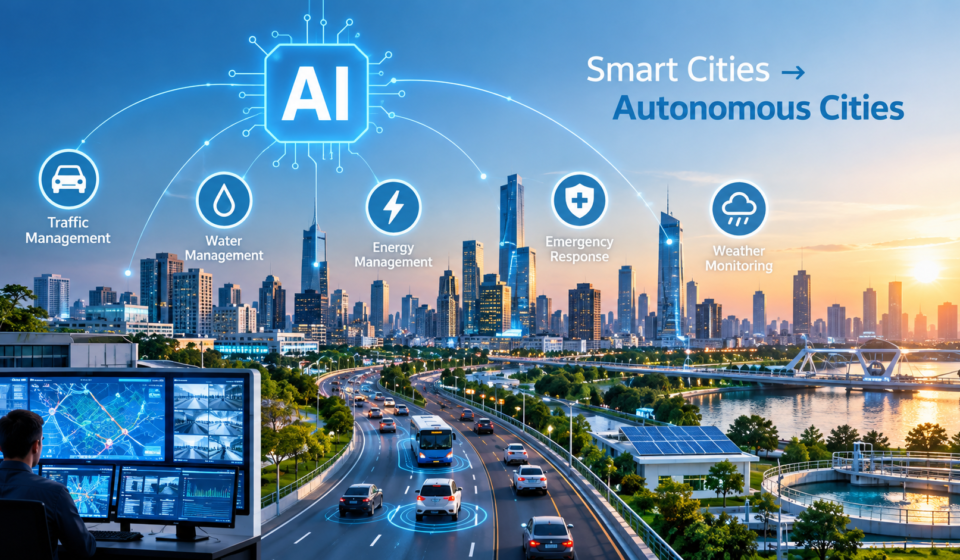

Artificial intelligence is rapidly changing the way people live and interact with cities. Over the past few years, smart cities have introduced connected sensors, intelligent traffic systems, digital public services, smart buildings, and automated infrastructure.
Now, the next stage is emerging: autonomous cities.
An autonomous city uses artificial intelligence, Internet of Things (IoT) devices, sensors, data platforms, digital twins, and connected infrastructure to understand what is happening across the urban environment and respond to changing conditions.
Instead of simply collecting information, these systems can analyze data, identify patterns, predict problems, and support or automate certain decisions.
This could change everything from transportation and energy management to waste collection, public safety, infrastructure maintenance, and government services.
What Is an Autonomous City?
A smart city mainly focuses on using technology and data to make urban services more efficient. An autonomous city takes this concept further by allowing connected systems to respond to situations with less manual intervention.
For example, a traditional traffic system may use fixed schedules for traffic signals. A smart traffic system can monitor traffic levels. An AI-powered autonomous traffic system could analyze traffic in real time and adjust signals according to changing conditions.
The same principle can be applied to many areas of city management.
An autonomous city could potentially:
- Detect traffic congestion and adjust traffic signals
- Predict infrastructure maintenance requirements
- Monitor energy consumption
- Identify water leaks
- Optimize waste collection routes
- Improve public transportation
- Support emergency response
- Automate routine government services
The goal is not to create cities where humans are no longer involved. Instead, AI can handle large amounts of information and repetitive tasks while humans continue to provide governance, oversight, and important decision-making.
How AI Is Changing Smart Cities
AI is becoming the intelligence layer that connects different parts of a city.
Sensors and connected devices generate enormous amounts of information every day. AI can analyze this information much faster than traditional systems and identify patterns that may otherwise be difficult to detect.
This allows cities to move from reactive services to predictive services.
Instead of waiting for a problem to occur, AI can help identify warning signs and allow city authorities to respond earlier.
This shift can make urban services faster, more efficient, and potentially more resilient.
AI and Smarter Transportation
Transportation is one of the areas where residents are likely to notice the impact of AI most clearly.
Cities constantly deal with traffic congestion, road accidents, parking problems, public transportation delays, and changing travel patterns.
AI can process information from traffic cameras, road sensors, GPS systems, public transport networks, weather services, and other sources.
This information can be used to understand current traffic conditions and predict where congestion may occur.
Intelligent Traffic Signals
AI-powered traffic signals can respond to real-time traffic instead of relying only on fixed schedules.
For example, if one road suddenly becomes heavily congested, an intelligent system could adjust traffic signals to improve traffic flow.
This can also help emergency vehicles move through busy areas more efficiently.
Smarter Public Transportation
AI can analyze passenger demand and transportation patterns to help cities improve routes and schedules.
Public transportation systems could potentially adjust services based on demand, major events, weather conditions, or unexpected disruptions.
As autonomous vehicles and self-driving technologies continue to develop, they could also become part of connected urban transportation networks.
Predictive Maintenance for City Infrastructure
Cities spend significant amounts of time and money maintaining roads, bridges, water systems, streetlights, buildings, and other infrastructure.
Traditionally, maintenance is often performed according to schedules or after a problem has already appeared.
AI introduces another approach: predictive maintenance.
Sensors can continuously monitor infrastructure for changes in temperature, pressure, vibration, water flow, or other conditions.
AI can analyze these signals and identify unusual patterns.
For example, an intelligent water-management system could potentially detect unusual pressure or flow patterns that indicate a possible leak.
Similarly, sensors on bridges or other structures could provide information that helps engineers identify areas requiring inspection.
This approach can help cities address problems earlier rather than waiting for major failures.
AI-Powered Energy Management
Energy consumption is another major challenge for modern cities.
Buildings, transportation systems, businesses, industries, and households all have different energy requirements throughout the day.
AI can analyze energy consumption patterns and help predict future demand.
Smart buildings can use AI to automatically manage:
- Heating and cooling
- Lighting
- Ventilation
- Electricity consumption
- Energy storage
- Equipment operation
For example, a building could reduce unnecessary energy consumption when fewer people are present.
At a wider level, AI can help cities coordinate energy supply and demand while supporting the integration of renewable energy sources.
Smarter Waste and Water Management
Waste and water services can also become more intelligent through AI and connected sensors.
Smart waste containers can monitor their fill levels and send information to collection systems. Instead of collecting every container on a fixed schedule, AI could help determine which locations require service.
Collection vehicles could then follow optimized routes based on demand and traffic conditions.
Water networks can benefit from similar technology.
Sensors can monitor water pressure, flow, consumption, and other conditions. AI can analyze this information and help identify unusual patterns that may indicate leaks or infrastructure problems.
This can help cities use resources more efficiently and reduce unnecessary waste.
Digital Twins: Creating a Virtual City
One of the most interesting technologies supporting autonomous cities is the digital twin.
A digital twin is a virtual representation of a physical environment that can be updated using real-world data.
For cities, a digital twin can represent roads, buildings, transportation networks, utilities, environmental conditions, and other infrastructure.
AI can analyze this virtual environment and help city planners test different scenarios.
For example, planners could examine how a new road might affect traffic or how heavy rainfall could affect certain areas.
They could also simulate energy demand, transportation changes, construction projects, and emergency situations.
This gives cities an opportunity to explore possible outcomes before making changes in the physical environment.
AI Can Make Public Services More Proactive
Government services could also change significantly as cities become more intelligent.
Today, many public services depend on residents reporting problems.
A resident may need to report a broken streetlight, damaged road, overflowing waste container, or other issue.
In a more autonomous city, connected systems could detect some of these problems automatically.
For example:
Traditional approach:
Resident reports a problem → Government receives request → Department investigates → Maintenance is scheduled
AI-enabled approach:
Sensor detects problem → AI analyzes information → Maintenance request is created → Department responds
This could reduce response times and allow city authorities to focus resources where they are most needed.
AI could also assist with routine administrative processes, helping residents access information and services more quickly.
AI and Emergency Response
AI could become an important tool for emergency management.
Cities generate information from weather systems, transportation networks, sensors, emergency reports, and infrastructure monitoring systems.
AI can analyze these different sources to help identify changing conditions.
During extreme weather, for example, AI could help identify areas that may face greater risks.
During a major road accident, intelligent transportation systems could identify disruptions and help redirect traffic.
Emergency management teams could also use digital models to simulate evacuation routes and emergency scenarios.
However, emergency and public safety applications require strong human oversight because mistakes can have serious consequences.
The Role of AI in Everyday Urban Life
The most interesting part of autonomous cities may be that residents do not always notice the technology directly.
AI could operate quietly in the background.
Imagine starting your day in a city where:
- Traffic signals automatically respond to congestion.
- Public transportation adjusts to passenger demand.
- Buildings optimize energy use.
- Water systems detect potential leaks.
- Waste collection routes change according to demand.
- Infrastructure systems identify maintenance requirements.
- Public services automatically respond to certain problems.
For residents, the city simply feels more responsive.
This is one of the biggest differences between traditional automation and autonomous urban systems.
The technology does not necessarily need to be visible. Its impact can be experienced through faster, smoother, and more responsive services.
Challenges of Autonomous Cities
Although AI offers significant opportunities, autonomous cities also create important challenges.
Data Privacy
Autonomous systems may collect large amounts of information about buildings, transportation, infrastructure, and public spaces.
Cities need clear rules about what data is collected, why it is collected, and how it is used.
Cybersecurity
The more connected a city becomes, the more important cybersecurity becomes.
A cyberattack against a critical urban system could potentially disrupt transportation, utilities, public services, or other infrastructure.
Human Oversight
Not every decision should be automated.
Cities need clear boundaries around which decisions AI can make and which decisions require human approval.
Interoperability
Different city departments often use different systems and technologies.
For autonomous systems to work effectively, these platforms need to communicate and exchange information securely.
Public Trust
Residents need confidence that AI systems are being used responsibly.
Transparency, accountability, privacy protections, and clear governance will therefore become increasingly important.
What Will the Future of Autonomous Cities Look Like?
The transition toward autonomous cities will not happen all at once.
Instead, cities are likely to introduce AI gradually across different services.
One city may begin with intelligent traffic management. Another may focus on energy optimization or predictive infrastructure maintenance.
Over time, these individual systems can become connected.
Transportation systems can communicate with traffic management.
Buildings can interact with energy networks.
Water systems can connect with infrastructure monitoring.
Government platforms can connect with public-service systems.
Eventually, cities could operate as interconnected digital ecosystems rather than as separate departments and services.
This is where the concept of the autonomous city becomes particularly important.
The city is no longer simply collecting data.
It is using data to understand, predict, coordinate, and respond.
Smart Cities vs. Autonomous Cities
The difference can be summarized simply:
| Smart Cities | Autonomous Cities |
| Collect urban data | Analyze and act on urban data |
| Use connected sensors | Connect multiple intelligent systems |
| Automate selected tasks | Coordinate complex workflows |
| React to problems | Predict and respond to problems |
| Human-led operations | Human oversight supported by AI |
| Individual smart services | Connected urban ecosystem |
The transition is therefore not about replacing smart-city technology.
It is about adding a higher level of intelligence and coordination.
Conclusion
AI is transforming the concept of the smart city and moving urban development toward a more autonomous model.
From intelligent transportation and predictive infrastructure to energy management, waste collection, digital twins, and automated public services, AI can help cities respond to changing conditions more quickly.
However, technology alone will not create successful autonomous cities.
Cities also need reliable infrastructure, high-quality data, cybersecurity, privacy protections, interoperability, responsible AI governance, and human oversight.
The future city may not simply be a place filled with connected devices.
It could become a continuously learning and responsive environment where technology helps identify problems, predict needs, and coordinate services.
AI is turning cities from systems that simply collect information into systems that can increasingly understand what is happening and respond to it.
That is the next major step in the evolution from smart cities to autonomous cities.