

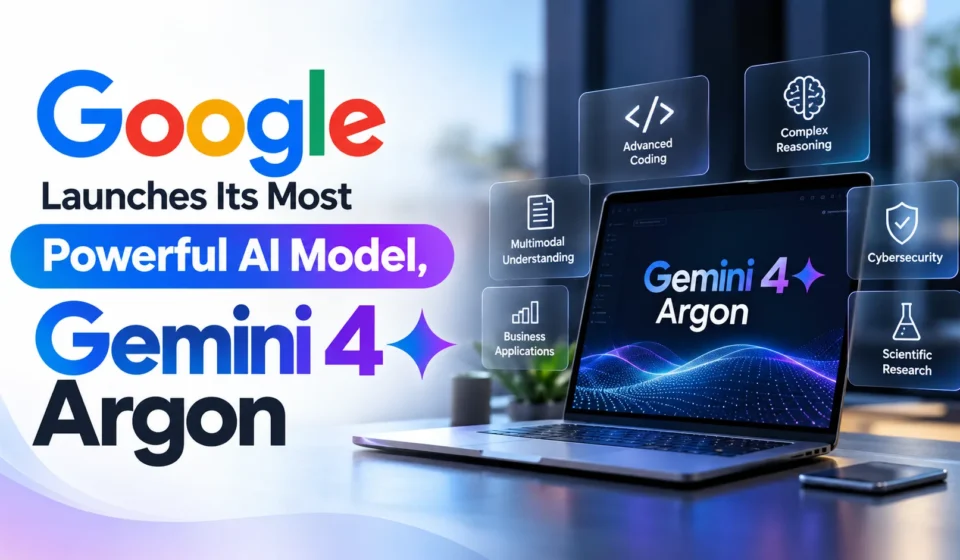

Google has introduced Gemini 4 Argon, a new artificial intelligence model designed to handle complex tasks involving software development, scientific research, cybersecurity and professional workflows. Announced on October 13, 2026, the model is built to solve challenging, multi-step problems that require advanced reasoning, technical understanding and the ability to process large amounts of information.
Unlike AI tools primarily used for everyday questions and content generation, Gemini 4 Argon focuses on more demanding tasks, including analysing large codebases, identifying software vulnerabilities, processing technical documents and supporting scientific investigations.
Google says the model is available through several of its developer, enterprise and consumer platforms, although access depends on the product and subscription plan. Its launch highlights the growing competition among AI companies to build models that can do more than generate text and can instead assist with practical, complex work.
What Is Google Gemini 4 Argon?
Gemini 4 Argon is Google’s latest frontier AI model, developed to solve complex real-world problems across multiple industries. According to Google, it combines advanced reasoning, visual understanding, domain knowledge and coding capabilities to support tasks that may require several connected steps.
The model is intended for developers, businesses, scientists, cybersecurity professionals and other users who need AI assistance with demanding projects.
For example, Gemini 4 Argon can help analyse a large software project, suggest code improvements, examine technical documents or support researchers as they investigate complex scientific questions. Google also describes its ability to work with AI agents, which can carry out sequences of tasks with less continuous human intervention.
The model is available through Google’s Gemini ecosystem, including the Gemini API and selected Google products.
Key Features of Gemini 4 Argon
Google highlights several capabilities that distinguish Gemini 4 Argon within its AI portfolio.
1. Advanced Reasoning for Complex Problems
Gemini 4 Argon is designed to work through multi-step problems rather than simply respond to isolated prompts. This can be useful when a task requires analysing information, planning an approach, evaluating possible solutions and checking the results.
Businesses may use these capabilities to review complex information, while developers and researchers can apply them to technical problems that require more than a straightforward answer.
2. Advanced Coding and Software Development
Software engineering is one of the model’s main focus areas. Google says Gemini 4 Argon can help with large-scale code refactoring, performance optimisation, debugging and other engineering tasks.
The model has been used internally at Google to support work on large codebases and improve software performance. Google also reported that its use in the Antigravity development environment increased agentic code submissions by more than 35% while reducing code rollbacks by nearly one-third.
These figures are based on Google’s own reported experience and should not be interpreted as guaranteed results for every development team.
3. Multimodal Understanding
Gemini 4 Argon supports work involving different types of information, including text, images, video, audio and PDF documents through the Gemini API.
This can help users analyse information that is spread across multiple formats. For instance, a professional could use AI to review documents alongside visual material, while researchers may benefit from combining technical reports with other relevant data.
Actual capabilities and supported inputs can vary depending on the product and API configuration.
4. Support for Scientific Research
Google says the model can assist with scientific and technical work in areas such as quantum computing, life sciences, molecular research and nuclear fusion.
Researchers may use AI to analyse technical literature, investigate hypotheses, optimise code used in scientific projects and explore possible solutions to difficult problems. These applications could help reduce the time spent on certain research tasks, although scientific conclusions still require appropriate validation and expert review.
5. Cybersecurity Analysis
Cybersecurity is another important area for Gemini 4 Argon. Google reports that the model can help identify software vulnerabilities, examine code for security weaknesses and support defensive security teams.
These capabilities could help organisations detect and address issues before they lead to security incidents. However, AI-generated security findings must be reviewed and tested by qualified professionals before changes are made to production systems.
Google says it has also developed safeguards intended to reduce misuse and help AI agents respect system permissions and security boundaries.
How Gemini 4 Argon Can Help Businesses
Gemini 4 Argon is designed for professional workflows in which accuracy, reasoning and the ability to work through several steps are important.
Finance and Business Analysis
Businesses may use the model to analyse financial information, organise complex documents, identify patterns and support analytical workflows. Human review remains essential for financial decisions, particularly where regulatory requirements or significant financial risks are involved.
Legal and Document Review
The model can help professionals process large collections of documents, summarise relevant information and organise findings. It can support legal research and document workflows, but it should not replace qualified legal advice or verification of legal sources.
Software Engineering
Development teams may use Gemini 4 Argon to review code, investigate bugs, improve performance and automate parts of their engineering processes. This could be particularly useful for organisations managing large software projects with complex dependencies.
Research and Innovation
Researchers can use AI assistance to process scientific literature, explore technical problems and accelerate selected computational tasks. Results must still be checked against reliable evidence and validated through suitable research methods.
Gemini 4 Argon and Google Antigravity
Google Antigravity is one of the environments through which eligible users can access Gemini 4 Argon. It supports AI-assisted development workflows in which agents can work through coding tasks and help execute multi-step engineering processes.
Google says its internal use of Argon through Antigravity has improved certain software engineering workflows, including code submissions and rollback rates.
The broader significance is the shift towards AI systems that can assist with entire workflows rather than only suggesting individual lines of code. Developers will still need to review changes, test applications and control the permissions granted to AI agents.
Gemini 4 Argon Availability
Google announced global availability for developers and enterprises through the Gemini API in Google AI Studio and the Gemini platform. Access is also available through selected Google products, depending on the user’s subscription.
According to Google’s announcement:
- Developers: Can access the model through the paid Gemini API tier and supported developer tools.
- Businesses: Can use it through supported enterprise offerings and API access.
- Eligible consumers: Google AI Pro and Ultra subscribers can access it through the Gemini app and AI Mode in Search, according to Google’s rollout details.
- Scientists and researchers: Google is offering eligible applicants the opportunity to receive six months of access to the highest Google Antigravity usage tier, subject to eligibility, capacity and selection.
- Cybersecurity defenders: Eligible organisations can explore access through Google’s Fairwind Program.
Availability, regional access, subscription requirements and product features may change over time, so users should check Google’s official announcement and product documentation before getting started.
Gemini 4 Argon Pricing
Google announced introductory API pricing of $2 per million input tokens and $10 per million output tokens. Cached input tokens are offered at a 95% discount under the announced pricing terms.
Google also stated that, after the introductory period ends on November 30, 2026, the public-access model’s pricing will change to $4 per million input tokens and $20 per million output tokens.
These rates apply to the model’s API pricing as described in Google’s announcement. They should not be confused with subscription fees for other Google products, and actual costs will depend on usage and the applicable pricing terms.
Businesses considering Gemini 4 Argon should estimate their expected token usage, test the model on representative tasks and compare the overall cost with the value it delivers.
What Makes Gemini 4 Argon Important for the AI Industry?
The launch reflects a broader change in artificial intelligence: companies are increasingly developing models intended to support complex, multi-step work.
Earlier AI applications often focused on answering questions, summarising text and generating content. More advanced systems aim to help users complete connected tasks, from understanding a problem to producing code, analysing evidence or preparing a structured output.
Gemini 4 Argon is Google’s entry in this area, with a particular emphasis on coding, professional workflows, cybersecurity and science.
However, no single model is automatically the best choice for every use case. Performance depends on the task, the quality of the input, the evaluation method, cost, reliability and integration with existing systems. Google’s benchmark claims should therefore be assessed alongside independent evaluations and practical testing.
Safety and Responsible AI Use
As AI systems become more capable, safety and oversight become increasingly important. A model that can analyse code, interact with tools or perform multi-step tasks may also create risks if it misunderstands instructions or is given excessive permissions.
Google says Gemini 4 Argon includes safeguards designed to reduce harmful use, resist prompt-injection attacks and encourage AI agents to respect system boundaries. The company also describes monitoring intended to identify potentially unsafe agent behaviour.
Organisations using advanced AI should still apply their own security controls. Recommended practices include limiting agent permissions, reviewing generated code, testing outputs, protecting sensitive information and requiring human approval before consequential or irreversible actions.
For high-stakes applications in healthcare, law, finance and cybersecurity, AI should support qualified professionals rather than replace their judgement.
Final Thoughts
Google Gemini 4 Argon represents Google’s effort to build AI that can handle more demanding technical and professional work. Its reported capabilities span software engineering, business analysis, cybersecurity and scientific research, while its availability through Google’s developer and enterprise platforms gives organisations a way to explore these applications.
The model’s practical value will depend on how reliably it performs in real-world situations, how much it costs to use and how well it fits into existing workflows. Google’s reported results offer an indication of its intended strengths, but independent testing and careful evaluation remain important.
For developers, businesses and researchers, Gemini 4 Argon is worth watching as the AI industry moves towards systems designed to assist with complete workflows rather than isolated tasks.


