

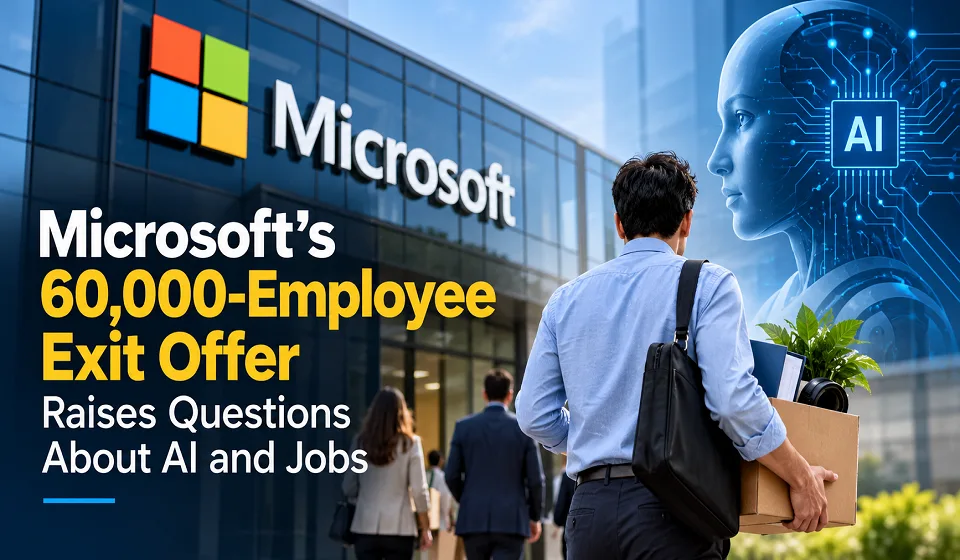

Microsoft has introduced a voluntary exit programme for eligible employees across India, the United States, the United Kingdom and Canada. The initiative, known as the Voluntary Exit Offer (VEO), could cover approximately 60,000 employees globally, bringing fresh attention to the changing employment landscape in the technology industry.
The announcement comes at a time when Microsoft and other major technology companies are investing heavily in artificial intelligence (AI). As AI tools become more capable of handling tasks across software development, customer support and business operations, questions are growing about how these technologies could reshape traditional jobs.
However, Microsoft has not stated that AI-driven job replacement is the reason behind this particular exit programme. The company describes it as a voluntary option that will help participating organisations adapt their workforce to changing business needs.
What Is Microsoft’s Voluntary Exit Offer?
Microsoft announced its Voluntary Exit Offer on October 26, 2026. The programme gives eligible employees the option to leave the company with financial support and career-planning resources.
According to the announcement by Amy Coleman, Microsoft’s Executive Vice President and Chief People Officer, the offer is available to eligible employees at internal level 70 and below in participating teams across India, the US, the UK and Canada.
The programme is not being introduced across every Microsoft department. Participation depends on individual business priorities, customer commitments and workforce requirements.
Eligible employees are expected to receive an email containing details of their offer. The decision to participate is voluntary, meaning the programme should not be confused with a compulsory layoff affecting all eligible employees.
Why Are 60,000 Microsoft Employees in Focus?
The figure of approximately 60,000 refers to the employees globally covered by the reported eligibility for the offer. It does not mean Microsoft plans to remove 60,000 jobs or that all these employees are expected to accept the package.
Microsoft has a global workforce of approximately 223,000 employees, according to figures reported by The Indian Express. The exit programme provides a way for selected business units to adjust their workforce while giving eligible employees an option to pursue opportunities outside the company.
For businesses, voluntary exit programmes can help manage workforce changes without requiring every departure to happen through compulsory redundancies. For employees, they can provide financial support and time to plan their next career move.
The actual number of employees who will accept Microsoft’s offer has not been publicly confirmed.
What Does the Microsoft Exit Offer Mean for Employees in India?
India is an important part of Microsoft’s global operations. The company employs approximately 23,000 people in the country, but it has not announced how many Indian employees are eligible for the new programme.
According to The Indian Express, employees in areas such as Copilot, AI experiences, Windows and Devices, Xbox, finance and human resources could be among those affected, depending on the participating business divisions.
The programme is understood to cover employees at Microsoft’s internal level 70 and below. However, not every employee at these levels will automatically qualify because participation is limited to selected teams.
For eligible employees in India, the reported exit package is broadly similar to Microsoft’s standard severance arrangements. It is understood to include:
- One month’s base salary for every completed year of service.
- Health insurance support.
- Career transition and planning assistance.
The reported deadline for eligible Indian employees to decide whether to accept the offer is December 1, 2026. Departures are expected by the end of December for employees who accept.
Employees should rely on the individual offer communication from Microsoft for the exact terms, benefits and applicable conditions.
Is Artificial Intelligence Behind Microsoft’s Workforce Changes?
The timing of Microsoft’s announcement has raised questions about the relationship between AI investment and employment.
Technology companies are increasingly using AI to automate repetitive tasks, assist software developers, manage customer queries and improve internal workflows. These capabilities can change how much time and human effort certain activities require.
Microsoft is also expanding its AI ecosystem through products and services such as Copilot, Azure AI and AI-powered business tools. As these technologies develop, the company must adapt its teams and skills to meet changing business requirements.
However, it is important to distinguish between industry-wide concerns and Microsoft’s stated reason for this specific programme. Microsoft has not explicitly said that AI is replacing the employees covered by its Voluntary Exit Offer.
The company has described the initiative as a way to provide employees with flexibility while allowing participating organisations to respond to changing workforce needs.
Therefore, the offer raises questions about AI and the future of jobs, but it does not prove that AI is directly responsible for the programme.
How Are Other Technology Companies Responding to AI?
Microsoft is not the only technology company reconsidering how its workforce is organised as AI capabilities expand.
Several companies have made changes to their staffing and operations in recent years:
Block: In February 2026, financial technology company Block announced plans to cut more than 4,000 jobs. Its CEO, Jack Dorsey, linked the decision to improvements in AI tools and the ability of smaller teams to accomplish more work.
Salesforce: The company has reduced its customer support workforce, with CEO Marc Benioff discussing how AI agents can handle a growing number of customer queries.
Livspace: The Indian home-interiors platform reportedly reduced around 1,000 positions in February 2026 while moving towards an AI-led operating model.
TCS: Tata Consultancy Services announced plans in July 2025 to reduce its workforce by approximately 12,000 employees, primarily in middle and senior management roles. The company cited changing business requirements and skill mismatches, rather than directly attributing the decision to AI replacing workers.
These examples show that workforce restructuring is taking place across the technology sector. However, the reasons differ from company to company, and not every job reduction should automatically be described as an AI-related layoff.
Microsoft Continues to Invest in India’s AI Ecosystem
Despite the voluntary exit programme, Microsoft has reiterated its commitment to India’s technology and talent ecosystem.
A company spokesperson stated that Microsoft has committed $20.5 billion between 2025 and 2029 towards cloud and AI infrastructure, skilling and operations in India.
The company has also said it remains on track to equip 20 million people across India with AI skills by 2030.
This highlights an important aspect of the changing technology landscape: companies may reorganise certain teams while continuing to invest in new technologies, infrastructure and specialised skills.
For India, the development is particularly significant because the country plays an important role in global software engineering, research and development, cloud services and AI innovation.
What Does This Mean for the Future of Technology Jobs?
Microsoft’s voluntary exit programme reflects a wider shift in how technology companies are thinking about workforce planning.
As AI tools become more integrated into everyday business operations, demand for certain traditional tasks may change. At the same time, companies will need professionals who can develop, manage, secure and apply AI systems effectively.
Skills in AI engineering, machine learning, cloud computing, cybersecurity, data management and AI governance could become increasingly important. Professionals in conventional technology roles may also benefit from learning how to work effectively with AI tools.
However, AI is unlikely to affect every profession or department in the same way. Human judgement, creativity, communication, problem-solving and specialised industry knowledge will continue to matter in many roles.
For employees, the changing job market makes continuous learning and skill development increasingly valuable. For companies, the challenge will be balancing automation and productivity with employee experience, responsible AI adoption and long-term business needs.
Conclusion
Microsoft’s Voluntary Exit Offer has brought renewed attention to the future of employment in the technology industry. While approximately 60,000 employees globally are reportedly eligible for the programme, this figure represents potential participants rather than confirmed job losses.
The offer is available only to eligible employees in selected teams across India, the US, the UK and Canada. Microsoft has not directly linked the programme to AI replacing human workers, even as the wider industry continues to examine how artificial intelligence is changing business operations.
As AI adoption grows, the technology sector is likely to see further changes in job responsibilities, workforce structures and skill requirements. Microsoft’s latest move is another example of how companies are adapting to this evolving environment.