

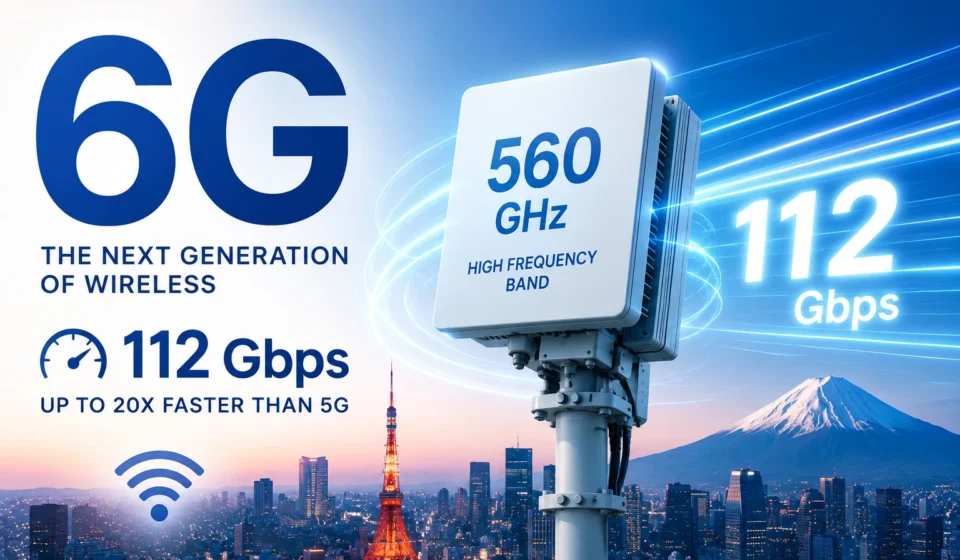

Japanese researchers have unveiled a groundbreaking 6G wireless prototype capable of reaching speeds of up to 112 Gbps, potentially making it around 20 times faster than current 5G networks.
The system reportedly operates in the 560 GHz frequency band, representing a major step forward in next-generation wireless communication technology.
As countries and companies race toward the future of ultra-fast connectivity, this breakthrough could help shape what the internet looks like beyond 5G.
What Makes This 6G Prototype Special?
The newly developed prototype achieved extremely high wireless transmission speeds using:
- Sub-terahertz frequencies
- Advanced wireless communication systems
- High-frequency spectrum technology
Researchers reportedly managed to transmit data at up to 112 gigabits per second (Gbps), far beyond the capabilities of most modern 5G networks.
How Fast Is 112 Gbps?
To understand the scale of this achievement:
Current 5G networks typically deliver speeds much lower than the experimental 112 Gbps demonstrated by the Japanese prototype.
At such ultra-fast speeds, future networks could potentially support:
- Instant cloud gaming
- Ultra-high-definition streaming
- Real-time holographic communication
- Advanced AI systems
- Massive smart-device ecosystems
This is why 6G is attracting global attention.
Why the 560 GHz Frequency Band Matters
The prototype reportedly uses the 560 GHz frequency band, part of the sub-terahertz spectrum.
Higher-frequency bands can:
- Transfer enormous amounts of data
- Increase wireless capacity
- Support extremely fast communication speeds
However, these frequencies also present major technical challenges because signals can:
- Travel shorter distances
- Be blocked more easily
- Require specialized infrastructure
Researchers are still working on solving these limitations.
How 6G Could Support AI and Future Technologies
6G is expected to play a major role in future AI-driven systems.
Ultra-fast wireless networks may eventually support:
- Autonomous vehicles
- Smart cities
- Advanced robotics
- Real-time AI communication
- Immersive AR and VR experiences
As artificial intelligence becomes more connected to real-time data systems, faster networks will become increasingly important.
The Global Race Toward 6G
Countries worldwide are already investing heavily in 6G research.
Major technology companies and governments see 6G as the next major evolution in communication infrastructure after 5G.
The competition includes:
- Japan
- China
- South Korea
- United States
- European research groups
Each region is working to develop faster, more reliable next-generation wireless systems.
Challenges Facing 6G Development
Despite the excitement, 6G technology is still in the experimental stage.
Some major challenges include:
- Infrastructure costs
- Signal limitations
- Energy efficiency
- Device compatibility
- Spectrum management
Commercial 6G networks may still take years before becoming widely available.
Could 6G Replace 5G Completely?
6G is expected to eventually succeed 5G, but the transition will likely happen gradually.
5G networks are still expanding globally, and many countries are continuing to build 5G infrastructure.
6G may first appear in:
- Research environments
- Enterprise systems
- Specialized industrial applications
before reaching mainstream consumers.
What the Future Could Look Like
If technologies like Japan’s 112 Gbps prototype continue improving, future wireless communication could become dramatically faster and more intelligent.
Future 6G systems may eventually enable:
- Near-instant communication
- AI-driven infrastructure
- Advanced connected environments
- Seamless real-time digital experiences
The internet of the future could look very different from today’s mobile networks.
Conclusion
Japan’s 6G wireless prototype achieving speeds of up to 112 Gbps marks a significant milestone in the future of communication technology. By operating in the 560 GHz frequency band and delivering speeds far beyond today’s 5G capabilities, the project highlights the enormous potential of next-generation wireless systems.
Although commercial 6G may still be years away, breakthroughs like this show how rapidly internet and communication technology continue evolving.