

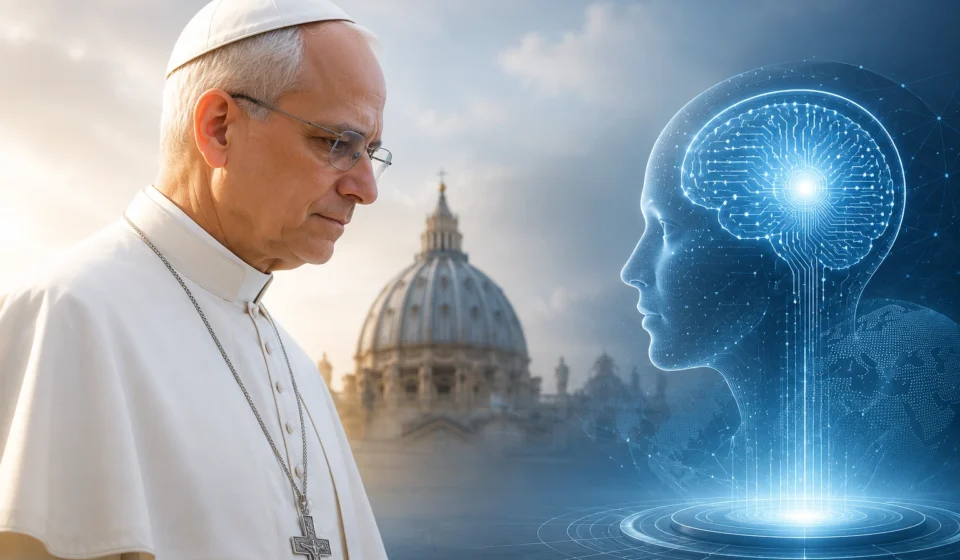

Pope Leo XIV has issued a major warning about artificial intelligence in a historic Vatican encyclical titled Magnifica Humanitas (“Magnificent Humanity”), released on May 25, 2026.
The document reportedly represents the Vatican’s most significant institutional response yet to the rapid rise of AI technology.
In the sweeping 42,300-word encyclical, Pope Leo XIV warned that unchecked artificial intelligence could:
- fuel warfare
- deepen inequality
- weaken human dignity
- concentrate technological power
- reshape society in dangerous ways
The Vatican also reportedly called for the global “disarming” of AI systems that could threaten humanity.
Why This Vatican AI Warning Matters
This is not simply a technology statement.
A papal encyclical is one of the highest forms of official teaching in the Catholic Church, giving the document major global moral and cultural significance.
The Vatican framing AI as a human dignity issue signals that concerns around artificial intelligence are no longer limited to:
- tech companies
- governments
- researchers
but are now becoming part of broader ethical and societal discussions worldwide.
The Vatican’s Main Concerns About AI
According to reports, the encyclical warns that AI could potentially:
- increase global inequality
- automate human labor excessively
- centralize power in large institutions
- erode human individuality
- contribute to autonomous warfare systems
The document reportedly stresses that technology should remain focused on serving humanity rather than replacing or diminishing human value.
The Debate Around Human Dignity and AI
One of the central themes of the encyclical is the idea of:
unique human dignity.
The Vatican reportedly expressed concern that AI systems could encourage societies to treat humans as:
- data points
- economic units
- replaceable systems
rather than individuals with moral, spiritual, and emotional value.
This reflects growing global discussions about how AI may impact human identity and social structures.
AI Ethics Is Becoming a Global Issue
The Vatican’s intervention highlights how AI ethics is becoming a worldwide concern involving:
- governments
- researchers
- businesses
- educators
- religious institutions
Questions surrounding:
- AI regulation
- AI safety
- automation
- surveillance
- autonomous weapons
are increasingly shaping international policy debates.
Concerns About AI and Inequality
The encyclical reportedly warns that advanced AI systems could worsen existing economic and social inequalities.
Critics of rapid AI expansion often argue that:
- wealth could become concentrated among a small number of technology companies
- automation may displace workers
- access to AI benefits may remain uneven globally
These concerns have become central to broader conversations about responsible AI development.
The Vatican’s Warning About AI Warfare
One of the strongest parts of the document reportedly focuses on military applications of AI.
The Vatican allegedly called for the global “disarming” of AI technologies that could contribute to:
- autonomous weapons
- AI-powered warfare
- large-scale surveillance systems
This reflects rising international concern about the use of artificial intelligence in military operations and conflict.
Technology vs Humanity?
The encyclical does not appear to reject technology itself.
Instead, the Vatican reportedly argues that innovation should remain:
- human-centered
- ethical
- socially responsible
The document encourages societies to ensure that technological progress strengthens humanity rather than weakening it.
Why This Could Influence Future AI Policy
Although the Vatican does not create technology laws, its moral influence is significant globally.
The encyclical may influence:
- public debate
- ethical frameworks
- academic discussions
- international AI policy conversations
especially in regions where religious and ethical institutions play an important societal role.
AI Is Becoming More Than a Tech Industry Issue
The Vatican’s warning demonstrates how artificial intelligence is increasingly viewed as:
a civilization-level issue.
AI discussions are now expanding beyond Silicon Valley into:
- philosophy
- ethics
- religion
- education
- geopolitics
This reflects how deeply AI may eventually impact human society.
Conclusion
Pope Leo XIV’s historic warning about artificial intelligence marks one of the strongest ethical statements yet from a major global institution regarding the future of AI. Through the encyclical Magnifica Humanitas, the Vatican raised concerns about warfare, inequality, and the protection of human dignity in an increasingly automated world.
As AI continues advancing rapidly, debates about ethics, responsibility, and humanity’s role in the age of intelligent machines are likely to become even more important.