


The growing competition between artificial intelligence platforms and traditional search engines has entered a new phase as advertising becomes an important part of the AI business model. However, a new research study suggests that ChatGPT advertisements are currently generating significantly less revenue per website visit than Google Search advertisements.
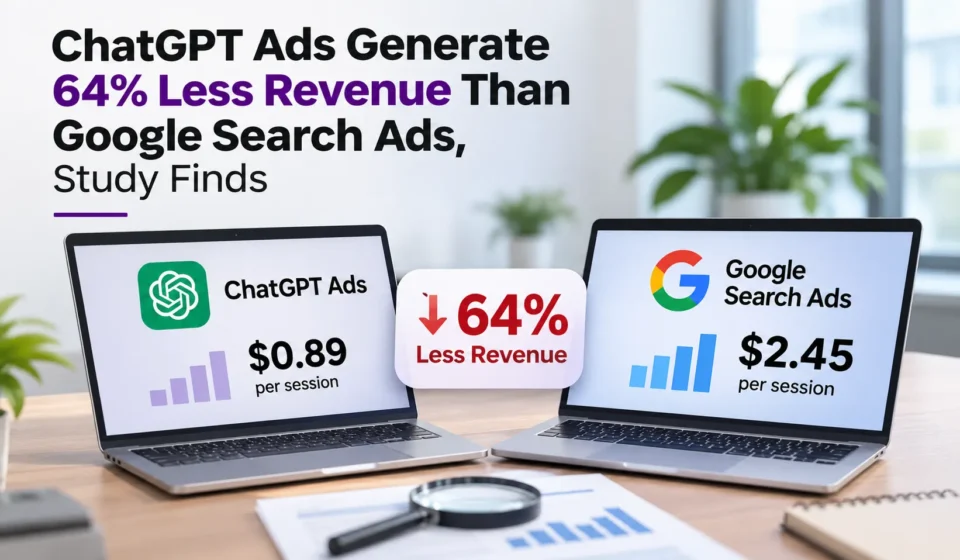
According to a working paper published in October 2026 by researchers Maximilian Kaiser of WU Vienna and Christian Schulze of Frankfurt School of Finance & Management, paid visits from ChatGPT advertisements generated 64% less revenue per session than visits from Google Search ads in the United States.
The research analysed nearly 10 billion website sessions across 1,898 e-commerce websites between June 2025 and August 2026. It examined advertising performance, customer conversions and changes in unpaid traffic from ChatGPT.
The findings raise important questions about the commercial potential of AI-powered advertising and whether conversational platforms can compete with established search advertising networks.
What Does the New Study Reveal About ChatGPT Ads?
The research paper, titled “Can Advertising Fund Free AI? Evidence from ChatGPT’s International Advertising Rollout,” examines whether advertising can become a sustainable revenue source for AI platforms while maintaining the value of their services.
One of its most important findings concerns the revenue generated by paid website visits.
In the US sample, a paid visit originating from ChatGPT advertising generated an average of $0.89 per session. In comparison, a paid visit from Google Search advertisements generated approximately $2.45 per session.
This represents a 64% revenue gap in favour of Google Search advertising.
The difference suggests that visitors arriving through Google Search advertisements were more valuable to the analysed e-commerce businesses during the measurement period.
However, the study does not establish that Google is more effective for every advertising objective or industry. Its comparison focuses on website revenue attributed to advertising-driven visits, primarily in e-commerce.
ChatGPT Ads vs Google Search Ads: Key Statistics
The study highlights several differences between the two advertising channels.
| Performance Metric | ChatGPT Ads | Google Search Ads |
| Revenue per session | $0.89 | $2.45 |
| Conversion rate | 0.37% | 1.17% |
The findings indicate that Google Search advertisements generated higher revenue per visit and achieved a higher conversion rate in the US sample.
The researchers also examined 87 advertisers using both advertising channels. According to the study, 84 of these advertisers, or approximately 97%, generated less revenue per ChatGPT visit.
Another important finding concerns advertising costs. Researchers estimated that a ChatGPT advertising click would need to cost approximately $0.26 to deliver a return comparable to Google Search advertising under the study’s assumptions.
One publicly disclosed ChatGPT advertiser was reported to have paid $1.72 per click.
These figures highlight the challenge of balancing advertising costs with the revenue generated by website visitors.
Why Are Google Search Ads Generating More Revenue?
One possible explanation is the difference in user intent between search engines and conversational AI platforms.
Google Search users often enter specific queries when looking for products, comparing prices or searching for a service. For example, someone searching for “buy wireless headphones online” may already be close to making a purchase.
This type of search behaviour can provide advertisers with a strong opportunity to reach customers who have clear purchasing intentions.
ChatGPT users, on the other hand, may use the platform for a wider range of activities, including:
- Researching products and services.
- Comparing different options.
- Asking for recommendations.
- Understanding technical information.
- Exploring ideas before making a purchase.
Although these interactions can influence purchasing decisions, they do not always indicate immediate buying intent.
This difference in user behaviour could help explain why paid ChatGPT visits generated less revenue per session in the study.
However, the research does not establish user intent as the sole cause of the revenue gap. Other factors, including advertising placement, campaign targeting, advertiser selection and pricing, may also influence performance.
ChatGPT Ads May Also Affect Organic Website Traffic
Another important part of the research examines whether introducing advertisements affects unpaid traffic coming from ChatGPT.
The researchers estimated that organic ChatGPT referrals to e-commerce websites declined by approximately 5.9% during the first 13 weeks after advertisements were introduced, compared with markets without ads.
After adjusting for assumed differences in regional ChatGPT usage growth, the estimated decline increased to between 7.2% and 8.4%.
However, there is an important distinction between referral volume and conversion performance.
The study found that the conversion rate of visitors arriving through organic ChatGPT referrals remained broadly unchanged.
The estimated conversion-rate change was just -0.02 percentage points from a pre-launch baseline of 2.21%, and the result was not statistically significant.
This suggests that the introduction of advertising may have affected the number of unpaid referrals without clearly changing the purchasing behaviour of visitors who continued to arrive through organic ChatGPT recommendations.
The researchers also caution that the estimated referral decline depends partly on assumptions about differences in ChatGPT usage across regions.
What Does This Mean for Advertisers and E-Commerce Businesses?
The findings provide an important reminder that new advertising platforms should be evaluated based on measurable business outcomes rather than their popularity or technological capabilities.
For e-commerce businesses, advertising performance depends on several factors, including traffic quality, conversion rates, customer acquisition costs and revenue per visitor.
The study highlights a few important considerations for advertisers.
1. Measure Revenue, Not Just Clicks
A high number of clicks does not necessarily translate into higher sales. Businesses should evaluate how much revenue each advertising channel generates and compare it with the cost of acquiring those visitors.
2. Compare Conversion Rates Across Platforms
Google Search and ChatGPT attract users with different search and interaction behaviours. Advertisers should monitor conversion rates separately instead of assuming that both platforms deliver similar results.
3. Evaluate Advertising Costs Carefully
The estimated $0.26 parity price in the study highlights how pricing can influence the financial performance of ChatGPT advertising.
Businesses should calculate their own acceptable cost per click based on profit margins, average order value and conversion rates.
4. Continue Monitoring AI-Driven Traffic
AI platforms are becoming another source of product discovery and website referrals. E-commerce businesses should monitor traffic from ChatGPT and other AI assistants to understand whether these visitors contribute to sales.
Does This Mean ChatGPT Ads Are Failing?
Not necessarily.
The research identifies a revenue and conversion gap between ChatGPT advertisements and Google Search advertisements within the analysed e-commerce sample.
It does not prove that ChatGPT advertising will remain less effective in the future.
AI advertising is still developing, and its performance may change as platforms improve targeting, advertising formats, recommendation systems and measurement capabilities.
Furthermore, revenue per website visit is only one way to evaluate advertising effectiveness.
Some businesses may use AI advertising to increase brand awareness, introduce new products or influence customers during the early stages of their buying journey. These outcomes may not immediately appear in revenue-per-session measurements.
Therefore, the study should be viewed as an early assessment of ChatGPT’s advertising performance rather than a final judgement on its long-term potential.
How Could This Affect the Future of AI Advertising?
The findings highlight a significant challenge for AI companies exploring advertising as a way to generate revenue.
Traditional search advertising benefits from established user behaviour, commercial search intent and a mature advertising ecosystem.
Conversational AI platforms operate differently. Users interact with AI assistants through questions, discussions and recommendations rather than relying exclusively on keyword-based searches.
For AI advertising to become more competitive, platforms may need to improve how advertisements reach relevant audiences while maintaining user trust and providing useful responses.
Advertisers will also need better measurement tools to understand how AI interactions influence purchases, including conversions that happen after the initial website visit.
The long-term success of AI advertising will depend on whether these platforms can deliver measurable business value without negatively affecting the user experience.
Conclusion
The new study comparing ChatGPT advertisements with Google Search ads reveals a significant difference in e-commerce advertising performance.
Paid ChatGPT visits generated an average of $0.89 per session, compared with $2.45 for Google Search advertisements in the US sample. The research also identified lower conversion rates for ChatGPT ads and a possible decline in unpaid ChatGPT referrals following the introduction of advertising.
However, these findings do not mean that AI advertising has no commercial future. They demonstrate that newer advertising channels must prove their value through measurable results.
As AI platforms continue developing their advertising models, businesses will need to evaluate traffic quality, conversion rates and revenue before deciding how much of their marketing budgets to allocate to these emerging channels.
For now, Google Search advertising appears to deliver stronger revenue per paid visit in the e-commerce data analysed by the researchers, while ChatGPT advertising remains an evolving opportunity.