

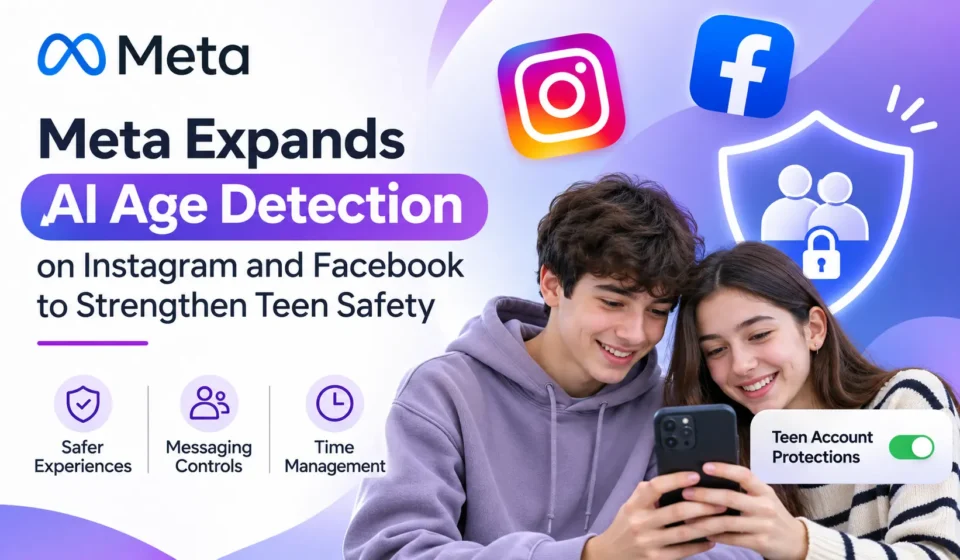

Meta is expanding its artificial intelligence (AI)-powered age-estimation technology globally to help identify teenage users and place them in age-appropriate safety settings on Instagram. The update aims to ensure that teenagers receive built-in protections even when they enter an incorrect date of birth while creating their accounts.
Announced on November 9, 2026, the expansion will help millions more teenagers access Instagram’s Teen Account protections. Meta is also continuing to roll out similar technology on Facebook, with a global expansion of comparable protections on Threads planned for later in 2026.
The announcement highlights Meta’s growing reliance on AI to improve age assurance and strengthen online safety for younger users.
What Is Meta’s New AI Age-Detection Update?
Meta is expanding its AI-powered age-estimation technology to identify accounts that may belong to teenagers, even when users have registered an adult date of birth.
Previously, some teenagers could potentially avoid age-based restrictions by entering an incorrect birth date during registration. Meta’s updated approach uses AI to identify accounts that may belong to younger users and place suspected teenagers into its built-in Teen Account protections.
With this global expansion, Meta expects millions more teenage Instagram users to receive age-appropriate settings.
The company says the technology is designed to look beyond the date of birth entered during account creation. It uses signals and contextual information to estimate whether an account may belong to a teenager.
Meta describes this as part of its broader age-assurance strategy, which aims to provide safer online experiences without relying exclusively on information supplied by users.
How Does Meta’s AI Technology Identify Teenagers?
Meta uses AI to analyse account-related information and identify signs that a user may be younger than the age listed on their profile.
The company’s age-estimation approach considers different types of signals rather than relying on a single piece of information.
These include:
1. Profile Information and Contextual Clues
AI systems can examine information across an account to identify contextual indicators associated with teenage users.
Examples include:
- References to birthday celebrations.
- Mentions of school grades.
- Information shared in profile biographies.
- Contextual details in posts and comments.
- Other activity-related signals that may indicate a user’s age group.
These signals help Meta estimate whether an account may belong to someone between 13 and 17 years old.
2. Visual Analysis of Photos and Videos
Meta has also described using visual analysis to help identify potentially underage users.
Its AI technology can examine general visual clues in photos and videos that may indicate a person’s approximate age.
For example, the system may consider broad visual patterns rather than relying only on written information.
Meta has clarified that this technology is not facial recognition. It does not identify a specific person in an image or create facial fingerprints. Instead, it looks for general visual indicators that may help estimate an age range.
This approach is intended to provide an additional signal when text-based information is insufficient.
3. Combining Multiple Signals
Rather than depending entirely on one indicator, Meta combines different signals to improve its age-estimation process.
This can help identify accounts that may belong to teenagers even when the birth date listed on the profile suggests that the user is an adult.
It is important to understand that AI age estimation is not the same as confirming someone’s exact date of birth. It helps the platform identify accounts that may require additional age-appropriate protections.
What Are Instagram Teen Account Protections?
Teen Accounts are designed to provide younger users with a more restricted and age-appropriate experience.
When Meta identifies an account as potentially belonging to a teenager, it can place that account into Teen Account protections.
These built-in safeguards cover several areas.
1. Messaging and Contact Restrictions
Teen Accounts include restrictions designed to limit who can contact teenagers.
These controls help reduce unwanted interactions and make it harder for unknown adults to reach younger users.
2. Age-Appropriate Content
Instagram applies content settings designed to limit teenagers’ exposure to certain sensitive or inappropriate material.
These restrictions are intended to create a more suitable browsing experience across the platform.
3. Time-Management Features
Teen Accounts also include time-management protections designed to encourage healthier platform use.
These features are part of the existing Teen Account experience. Meta’s November announcement is primarily about expanding AI age estimation, not introducing a new universal screen-time limit.
4. Parental Supervision
Parents can use Instagram’s supervision tools to gain additional visibility into aspects of their teenager’s account experience.
These tools are intended to help families understand platform activity and manage certain safety settings.
The exact protections and controls available can depend on the user’s age, account settings and location.
Which Meta Platforms Are Getting AI Age Detection?
Meta’s November announcement covers different stages of expansion across its platforms.
| Platform | Status |
|---|---|
| AI age-estimation technology expanding globally | |
| Technology rollout continuing | |
| Threads | Similar technology planned for global rollout later in 2026 |
| Messenger | Existing Teen Account protections available |
Instagram is the main focus of the November 9 announcement, with millions more teenagers expected to receive its built-in protections.
Meta says it is continuing to expand the technology on Facebook. The company also plans to begin introducing similar technology globally on Threads later in 2026.
It would therefore be inaccurate to say that the complete global AI age-detection rollout has already been finished across every Meta platform.
Meta Introduces Apple’s Age-Range Signal in Australia
Another important part of Meta’s announcement concerns its use of Apple’s age-range signal in Australia.
This provides an additional way for Meta to understand the approximate age of people using its apps.
The process works through Apple’s age-range sharing system:
- A parent sets up a smartphone for their teenager.
- The app store can determine an age range for the person using the device.
- When the teenager downloads an app, Apple can share the relevant age-range information with the app developer.
- The developer can use that information as an additional signal to determine whether the user meets the app’s age requirements.
Meta says it has started using this signal in Australia as an additional method of understanding users’ ages.
However, this process depends on optional participation by app stores and developers. It is not a mandatory age-verification system applied to every Australian user.
Meta argues that a consistent age signal shared across apps could reduce the need for every individual platform to collect age-verification information separately.
What Will Parents Notice After This Update?
Meta is also introducing additional communication for parents.
During November 2026, parents in the United States will begin receiving an in-feed video on Instagram explaining how the platform places teenagers into age-appropriate protections.
The video will link to information about Meta’s age-assurance approach and how parents can help ensure their teenagers have provided accurate age information.
The company is also encouraging parents to discuss online age requirements with their children.
For families, the expansion could mean that teenagers receive age-appropriate protections even when they have entered an incorrect birth date.
However, AI age estimation is not guaranteed to identify every teenage account correctly. Parents should continue using available supervision tools and discussing online safety with their children.
Why Is Meta Expanding AI Age Detection Globally?
Meta’s decision reflects the growing challenge of protecting teenagers across social media platforms.
Many online services rely on users entering their own birth dates. However, teenagers may sometimes provide inaccurate information to access features or experiences intended for adults.
This creates difficulties for platforms that need to provide age-appropriate content and safety settings.
Meta’s AI expansion aims to address this problem by identifying accounts that may belong to teenagers, even when the registered age is incorrect.
There are several important reasons behind this approach.
Improving Teen Safety
Identifying teenagers more accurately can help Meta apply its existing safety protections to more accounts.
This may reduce the number of younger users who access adult-oriented experiences by entering an incorrect birth date.
Strengthening Age Assurance
AI-based age estimation gives Meta another way to assess whether an account’s registered age is accurate.
Combining account information, contextual signals and visual analysis can provide additional indicators beyond self-reported birth dates.
Responding to Online Safety Regulations
Governments around the world are introducing regulations intended to improve online safety for children and teenagers.
Meta says its expansion builds on an agreement with 52 bipartisan attorneys general across US states, territories and the District of Columbia.
As part of that agreement, Meta is investing in stronger technology to identify accounts that may belong to children under 13 and teenagers aged 13 to 17.
The company is also calling on other technology platforms, including TikTok and YouTube, to adopt similar practices.
Privacy Concerns and Limitations of AI Age Estimation
Although AI-powered age detection may improve online safety, it also raises questions about privacy, accuracy and the handling of user information.
1. Risk of Incorrect Age Estimates
AI systems may sometimes mistake an adult for a teenager or fail to identify an account that belongs to a younger user.
Incorrect estimates could result in restrictions being applied to the wrong accounts.
2. Questions About Data Privacy
Analysing account information, posts and images to estimate age raises questions about how platforms process personal information.
Meta says its visual analysis is not facial recognition and does not identify individuals in photos. Nevertheless, users may still want greater transparency about how age-estimation signals are collected and evaluated.
3. The Need for Age Verification Options
AI estimates are not equivalent to verified identity information.
Users who believe their account has been placed into the wrong age category may need to follow the platform’s available age-confirmation or appeal process.
4. Different Rules Across Countries
Age-assurance requirements vary between countries. The availability of certain technologies and protections may therefore differ depending on local regulations and rollout schedules.
These limitations show why AI-based age estimation should be treated as one part of a broader online safety system rather than a perfect solution.
What Happens Next?
Meta says it will continue improving its age-assurance technology and expanding its use across its platforms.
The next developments include:
- Continuing the global expansion of AI age estimation on Instagram.
- Further rollout of similar technology on Facebook.
- Beginning a global rollout of similar technology on Threads later in 2026.
- Improving systems to identify accounts that may belong to children under 13.
- Strengthening age estimation for teenagers who register an incorrect adult birth date.
- Continuing its work with parents and policymakers on online safety.
The company has not provided a single completion date for every platform and country.
Conclusion
Meta’s global expansion of AI age detection marks another step in its efforts to improve online safety for teenagers.
By using AI to identify accounts that may belong to younger users, the company aims to ensure that more teenagers receive Instagram’s built-in Teen Account protections, even when they provide an incorrect birth date.
The update also highlights Meta’s broader plans for Facebook and Threads, along with its use of Apple’s age-range signal in Australia.
However, AI age estimation is not a perfect verification method. Questions about accuracy, privacy and incorrect age classifications will remain important as the technology expands.
For parents and teenagers, the update represents an additional layer of protection, but responsible platform use, parental guidance and transparent age-assurance practices will continue to be essential.