
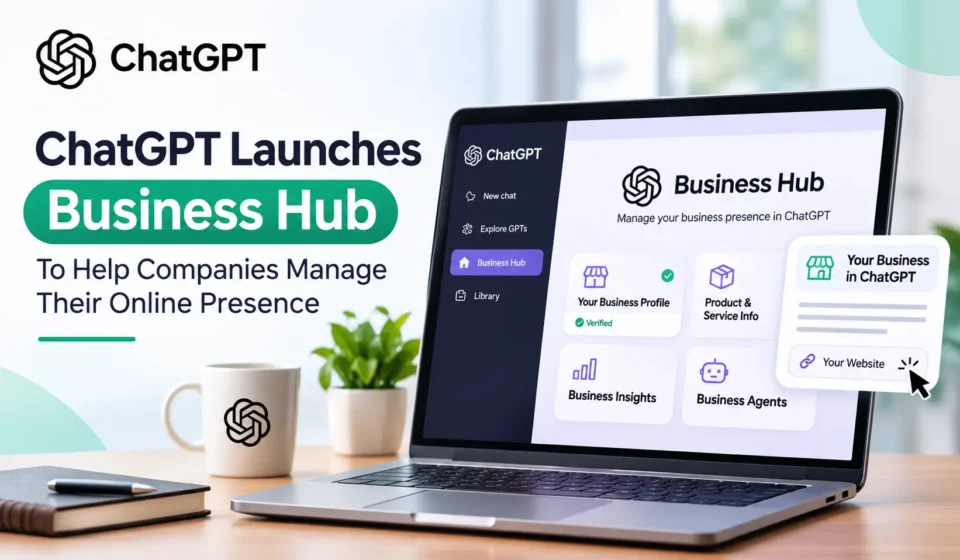

OpenAI is introducing a new way for companies to manage how their businesses appear within ChatGPT. The company has launched Businesses in ChatGPT, a beta initiative that allows eligible businesses to claim their profiles, update company information, share product details and understand how users discover and interact with their businesses.
Announced on November 10, 2026, the initiative introduces a centralised platform called Business Hub. It gives businesses more control over the information available about their products and services when people use ChatGPT to research companies, compare options and make purchasing decisions.
The launch also introduces Business Agents, which allow eligible companies to create AI-powered experiences that answer customer questions and help users explore their offerings.
The development represents another step in OpenAI’s effort to make ChatGPT a platform for business discovery, bringing elements of online business listings and customer engagement into conversational AI.
What Is OpenAI’s New Business Hub?
Business Hub is a centralised space within ChatGPT where business owners and authorised representatives can claim and manage their business presence.
Through this platform, eligible companies can:
- Claim and verify their business listings.
- Update important business information.
- Share product details, pricing and availability.
- View aggregated business engagement insights.
- Create Business Agents if they meet the eligibility requirements.
The main purpose is to help businesses provide accurate and up-to-date information that ChatGPT can use when responding to relevant customer questions.
For example, someone asking ChatGPT to recommend a particular type of product or compare service providers may receive information about businesses relevant to their request.
By allowing companies to maintain their information through Business Hub, OpenAI aims to make business discovery more useful and accurate.
The feature is currently available in beta, with eligibility depending on factors such as business location, industry and verification requirements.
How Does ChatGPT Business Hub Work?
Business Hub provides several tools that help companies manage their information and understand how they appear within ChatGPT.
1. Claim and Verify Your Business Profile
Eligible business owners or authorised representatives can search for their business through Business Hub and claim the corresponding listing.
Businesses must complete a verification process to demonstrate that they are authorised to manage the organisation’s information.
Depending on the business, available verification methods may include:
- Business email verification.
- Business phone verification.
- Website domain verification.
- Shopify integration.
OpenAI also requires identity verification through Persona before businesses can publish information updates, access insights or create an eligible Business Agent.
Once the claim is approved, businesses can manage their information through Business Hub.
2. Update Business Information
After verification, businesses can update important details about their organisation.
This may include information about their products, services and other business offerings.
Retailers can also connect product feeds containing information such as:
- Product names and descriptions.
- Product pricing.
- Product availability.
- Other relevant product details.
This information can help ChatGPT provide users with more accurate details when they ask product-related questions.
For e-commerce businesses, maintaining accurate product information is particularly important because prices and availability can change frequently.
3. View Business Engagement Insights
Business Hub also introduces an analytics feature that helps companies understand how people interact with their business through ChatGPT.
Businesses can access aggregated insights, including:
- Business mentions: How often the business is mentioned in ChatGPT.
- Website clicks: How often users click through to the business website.
- Discovery topics: Common themes in conversations where the business website is cited.
- Profile views: Profile engagement information shown in the Business Hub dashboard.
These insights can help companies understand which topics are generating interest and how their business information appears in AI-powered discovery.
However, these analytics are not equivalent to access to individual customer conversations.
OpenAI says it does not share users’ conversations or Business Agent chats with businesses. Insights are aggregated and only displayed when sufficient interactions meet the required privacy thresholds.
What Are ChatGPT Business Agents?
Alongside Business Hub, OpenAI is introducing Business Agents, another feature designed to help companies interact with potential customers.
A Business Agent is an AI-powered experience that can answer questions about a company’s products, services and policies using information provided by the business.
For example, imagine a customer searching for a suitable product.
They may discover a business through a ChatGPT response and open its verified business profile. If the company has published a Business Agent, the customer can start a separate conversation to ask more specific questions.
A Business Agent could help with:
- Explaining product features.
- Comparing different product options.
- Answering questions about services.
- Providing information about company policies.
- Helping customers understand which offering suits their requirements.
Businesses can configure their agents using information and guidelines they provide.
Importantly, Business Agent conversations are clearly labelled and kept separate from ChatGPT’s independent answers. This distinction helps users understand when they are interacting with a business representative powered by AI.
Business Agents are initially available to eligible e-commerce and online service businesses in the United States. Businesses must meet OpenAI’s requirements, complete verification and review and publish their agent before customers can interact with it.
This availability is separate from the ability to claim an eligible business profile.
How Is ChatGPT Business Hub Different From Google Business Profile?
OpenAI’s new Business Hub has similarities to Google Business Profile because both platforms allow businesses to manage information that users may encounter while researching companies.
However, their functions and environments are different.
| Feature | ChatGPT Business Hub | Google Business Profile |
|---|---|---|
| Main purpose | Manage business information within ChatGPT | Manage business presence across Google Search and Maps |
| Business verification | Required to manage claimed information | Required for profile management |
| Product information | Product feeds with pricing and availability | Product and business information through supported features |
| Customer discovery | AI-powered conversations | Search and Maps |
| Business insights | Mentions, website clicks and discovery topics | Search, Maps and customer interaction performance |
| AI interaction | Eligible businesses can publish Business Agents | Google offers separate AI-powered business and customer tools |
The key difference is how customers discover businesses.
Google Business Profile is closely connected to traditional search and local discovery, while Business Hub is designed around conversational AI interactions.
This means businesses may increasingly need to maintain accurate information across multiple discovery platforms rather than depending on a single source.
Why Is OpenAI Introducing Business Profiles?
People increasingly use AI tools to research products, compare companies and explore services before making decisions.
ChatGPT is becoming part of this discovery process, creating an opportunity for businesses to connect with potential customers through conversational interactions.
OpenAI’s new initiative addresses several important areas.
1. Improving Business Information Accuracy
Business information can become outdated when companies change their services, pricing, product availability or policies.
Business Hub gives eligible businesses a way to submit updated information directly to OpenAI.
This can help ChatGPT provide more relevant details when users ask questions about specific companies and their offerings.
However, submitting information does not guarantee that every detail will appear in every ChatGPT response.
2. Creating More Opportunities for Business Discovery
People may use ChatGPT to ask questions such as:
- Which digital marketing agencies offer SEO services?
- What are the best products for a home office?
- Which companies provide website development?
- Can you compare these two service providers?
Business profiles give companies another way to provide relevant information when users explore these topics.
3. Connecting Business Discovery With Customer Interaction
Business Agents introduce an additional step beyond simply displaying company information.
Instead of only reading a business description, eligible customers can interact with a company’s AI-powered agent to ask questions and explore its products or services.
This could help businesses provide more information during the customer research process.
4. Giving Businesses Better Visibility Insights
Understanding how people discover a business through AI platforms is becoming increasingly important.
The aggregated insights available in Business Hub can help companies identify common discovery topics and understand how often their businesses are mentioned or receive website clicks.
These metrics provide another perspective on customer discovery beyond traditional website analytics.
What Does This Mean for SEO and Digital Marketing?
The introduction of Business Hub could have implications for SEO professionals, digital marketing agencies and businesses that depend on online visibility.
Search engine optimisation has traditionally focused on improving visibility in search engine results pages.
However, customers now use several channels to discover products and services, including AI assistants and conversational search platforms.
OpenAI’s announcement highlights the growing importance of managing business information for AI-powered discovery.
1. Business Information Optimisation
Businesses should maintain consistent and accurate information across their websites, product feeds and online listings.
Important details include company descriptions, service information, contact details, product specifications and pricing.
Accurate information can help reduce inconsistencies when AI systems retrieve details from different sources.
2. Product Feed Management
For online retailers, product information is an important part of the new ecosystem.
Businesses that provide accurate product feeds can make it easier for ChatGPT to understand their offerings, including pricing and availability.
Retailers should regularly review their product data to avoid outdated prices, incorrect descriptions and unavailable products being represented inaccurately.
3. Understanding AI Search Visibility
Traditional SEO reports often focus on keyword rankings, impressions, clicks and organic traffic.
Business Hub introduces additional metrics related to how companies appear in ChatGPT, including mentions and discovery topics.
These insights could help digital marketers understand which subjects are associated with their businesses in AI-powered discovery.
However, ChatGPT business insights should complement existing SEO analytics rather than replace them.
4. Building Trust Through Accurate Information
Businesses should focus on providing useful, factual and current information rather than attempting to manipulate AI recommendations.
A complete business profile, reliable product details and clear service descriptions can help customers understand what a company offers.
Claiming a profile does not guarantee better rankings, preferential recommendations or increased sales.
Who Can Claim a Business on ChatGPT?
OpenAI says eligible businesses located in countries where ChatGPT is available can claim their business through Business Hub.
However, availability depends on several factors, including:
- Business location.
- Industry and business category.
- Verification and integrity checks.
- Whether the person claiming the listing owns the business or is authorised to represent it.
Existing OpenAI Enterprise customers and advertisers can also work with their OpenAI representatives to claim their businesses.
Eligible Shopify merchants have an additional integration option. They can connect their stores through Business Hub or the Shopify administration area to streamline verification and product information sharing.
Business Agents have separate and more limited eligibility requirements. At launch, they are available to eligible e-commerce and online service businesses in the United States that meet OpenAI’s requirements.
Therefore, businesses should not assume that every company eligible to claim a profile can immediately publish a Business Agent.
How Can Businesses Get Started With Business Hub?
Businesses interested in managing their presence on ChatGPT can follow these general steps:
Step 1: Open Business Hub
Access Business Hub through ChatGPT on the web and search for the business listing.
Step 2: Claim the Business
Select the correct business and confirm that you own it or are authorised to represent it.
Step 3: Complete Verification
Use one of the verification methods offered for the business, such as a business email, phone number, website domain or Shopify connection.
Step 4: Complete Identity Verification
After the business claim is approved, complete the required identity verification through Persona.
Step 5: Update Business Information
Publish relevant business details and connect a product feed if applicable.
Step 6: Review Available Insights
Use the available metrics to understand business mentions, website clicks and common discovery topics.
Eligible businesses can separately explore creating and publishing a Business Agent after completing the required steps.
Businesses can begin through the official ChatGPT Business Hub.
Does Claiming a ChatGPT Business Profile Guarantee Better Visibility?
No. Claiming a business profile does not guarantee that a company will appear more frequently in ChatGPT recommendations or receive a higher position in responses.
OpenAI continues to generate independent recommendations and comparisons based on users’ questions and relevant information.
A claimed profile allows an authorised business representative to manage submitted information and access eligible tools. It does not provide exclusive control over everything ChatGPT says about the company.
Businesses should therefore view Business Hub as an information-management and engagement platform rather than a guaranteed SEO ranking tool.
The long-term value will depend on how users interact with business profiles, how accurately information is represented and how OpenAI develops the platform.
What Happens Next?
OpenAI describes Businesses in ChatGPT as an early step towards bringing companies more deeply into its AI ecosystem.
The company plans to expand Business Hub and Business Agents to additional markets and business categories over time.
It also intends to develop more tools for organisations with complex business requirements.
For now, the focus is on three main areas:
- Helping businesses provide accurate and current information.
- Giving companies aggregated insights into how users discover them.
- Enabling eligible businesses to interact with customers through Business Agents.
As these capabilities develop, ChatGPT could become another important channel for businesses looking to connect with customers during online research and product discovery.
Conclusion
OpenAI’s launch of Business Hub marks an important development in the relationship between AI platforms and businesses.
Through Businesses in ChatGPT, eligible companies can claim their profiles, update business information, share product feeds and access insights about how users discover them.
The introduction of Business Agents adds another capability by allowing eligible businesses to answer customer questions through dedicated AI-powered conversations.
For SEO professionals and digital marketers, the announcement highlights the growing importance of accurate business information and visibility across AI-powered discovery platforms.
However, Business Hub is still in beta, Business Agent availability is limited, and claiming a profile does not guarantee higher rankings or more customers.
Businesses should monitor the rollout, check their eligibility and consider how accurate information across AI platforms can support their wider digital marketing strategy.